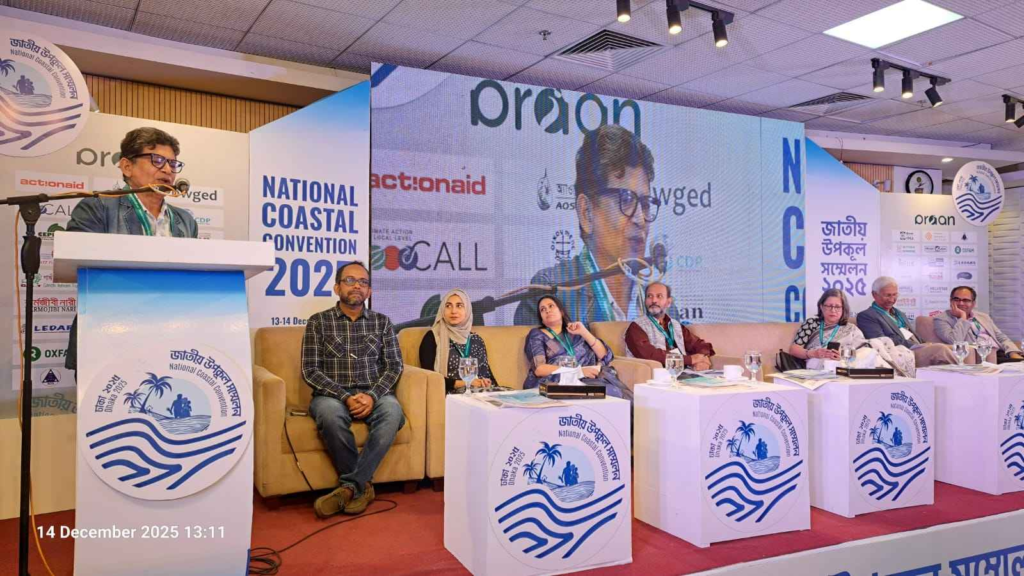
Closing Day | 14 December 2025 | Dhaka
The National Coastal Conference 2025 concluded with a clear message: Bangladesh can no longer treat its coast merely as a zone of climate vulnerability. The coast must be recognised as a strategic national region—one that carries enormous climate risks while also driving agriculture, fisheries, the marine economy, trade and international connectivity.
After two days of dialogue among policymakers, researchers, civil-society organisations, development partners and representatives of coastal communities, the conference closed in Dhaka on 14 December 2025 with the presentation of the National Coastal Declaration 2025.
The declaration transformed the discussions of the conference into a broader policy agenda for a just, resilient and sustainable future for coastal Bangladesh.
The Coast Is More Than a ‘Primary Battlefield’
Speaking as the Chief Guest at the closing session, Dr. Hossain Zillur Rahman, Executive Chairman of the Power and Participation Research Centre (PPRC) and former Adviser to a Caretaker Government, challenged the conventional image of coastal Bangladesh.
He acknowledged that the coast carries some of the country’s heaviest climate risks and is often considered the “primary battlefield” of disaster and climate vulnerability.
But, he argued, that is only one part of the story.
The coastal region is also opening new possibilities in agriculture and is increasingly important to Bangladesh’s marine economy and international connectivity. It should therefore be recognised not simply as a vulnerable region, but as an important driver of the national economy.
The conference report similarly records his call for coastal communities to move beyond the mindset of being applicants for assistance and see themselves as active actors capable of influencing national development. He also proposed developing a regular “State of the Coast” report to build a stronger evidence base for policymaking.
The coast should not be defined only by the risks it carries, but also by the value it creates.
From ‘Victims’ to Contributors
This shift in narrative was echoed strongly throughout the closing session.
Farah Kabir, Country Director of ActionAid Bangladesh, stressed that coastal people should not be portrayed simply as vulnerable communities or victims waiting for assistance.
Instead, they must be recognised as economic contributors.
She called for a clearer assessment of how much coastal communities contribute to Bangladesh’s GDP and wider economy so that policymakers can understand the region through the lens of national contribution rather than charity.
Her message was equally direct: coastal communities are not asking for sympathy; they are asking for recognition, rights and accountability.
She also emphasised decentralisation, transparent climate finance, sustainable livelihoods and stronger implementation of existing national plans rather than relying only on the creation of new bureaucratic institutions.
A Roadmap, Not Just Recommendations
For Nuzhat Jabeen, Country Director of Christian Aid Bangladesh, the conference recommendations reflected the actual needs and lived experiences of coastal people.
She highlighted issues including the freshwater crisis, women’s health and the lack of secure livelihood opportunities.
But she also stressed that recommendations alone would not be enough.
The demands emerging from the conference, she argued, should be organised around a clear timeframe and roadmap, while the National Coastal Conference itself should continue as a long-term platform for monitoring and advocacy.
That approach would allow stakeholders not only to raise demands, but also to track whether commitments are actually being implemented.
Development Must Be Led by Communities
The question of who controls coastal development was another central theme.
Fatema Tuz Zohra of Oxfam in Bangladesh argued that the coast should also be recognised for its potential in the blue economy and renewable energy.
However, she warned that development cannot simply mean more factories, large infrastructure or higher GDP figures.
Sustainable coastal development must protect the distinctive ecology of the region and ensure that solutions emerge from communities themselves.
Communities should not be included merely as symbolic participants after decisions have already been made. They need a meaningful role in designing solutions and control over initiatives that affect their lives and resources.
She also emphasised greater transparency and accountability in climate finance and stronger local access to those resources.
The National Coastal Declaration 2025
The defining outcome of the closing day was the presentation of the National Coastal Declaration 2025.
The declaration recognises Bangladesh’s coast as a strategic national region spanning 19 districts and supporting approximately 43.5 million people.
It identifies the coast as fundamental to food production, agriculture, fisheries, waterways, port-based trade, energy, infrastructure, industry, tourism and climate adaptation—while acknowledging that the rights, safety and quality of life of coastal people have not been secured in proportion to this national contribution.
Among the priorities highlighted in the declaration and closing-day media coverage were:
- scientific surveys and mapping of the coastline, freshwater resources, agricultural land, fisheries and other natural assets;
- land zoning and region-sensitive development planning;
- strict Environmental Impact Assessment (EIA) for development projects;
- recognition of the role of fishers, farmers, women and youth in managing coastal resources;
- greater authority for community-based natural-resource co-management;
- protection of groundwater and freshwater sources in salinity-affected areas;
- community-based freshwater management programmes; and
- improved local access to climate finance, Loss and Damage funding and green finance.
The declaration also calls for integrated coastal planning, evidence-based policymaking, region-specific approaches and stronger financial accountability.
An Institutional Space for Coastal Voices
Gawher Nayeem Warra, Convener of the National Coastal Conference 2025, emphasised that coastal people need more than another administrative structure.
They need a trusted space where they can raise objections, share experiences and directly communicate their concerns.
He called for stronger local participation, better use of coastal data and closer engagement with universities and research institutions so that policy decisions reflect both scientific evidence and realities on the ground.
The final declaration was presented on behalf of the organising committee by Hasan Mehedi, Chief Executive of the Coastal Livelihood and Environmental Action Network (CLEAN), reflecting the demands and rights of people across Bangladesh’s coastal districts.
The Conference Ends, the Responsibility Begins
The National Coastal Conference 2025 succeeded in bringing multiple voices into one national conversation—government officials, researchers, development organisations, farmers, fishers, women, youth and people living with the everyday consequences of climate and environmental change.
But the real test begins after the conference.
A declaration will matter only if its principles shape national budgets, development planning, climate finance, investment decisions, environmental governance and political commitments.
Coastal people do not need to be repeatedly described as helpless victims of climate change.
They need the power to shape the decisions that determine their future.
The conference has ended. The coastal agenda must now move from dialogue to delivery.
Protecting Bangladesh’s coast is not only about responding to disasters.
It is about protecting people, ecosystems, livelihoods and a vital foundation of the national economy.
The National Coastal Declaration 2025 has set out a direction.
Now is the time to turn that direction into action.