In a groundbreaking localized move to combat food waste and foster responsible consumption, more than ten restaurants and hotels in Noakhali have stepped forward to track, record, and publicly display their daily food waste.
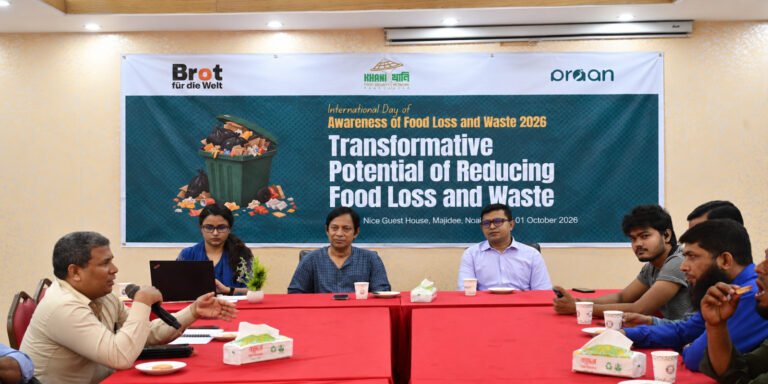
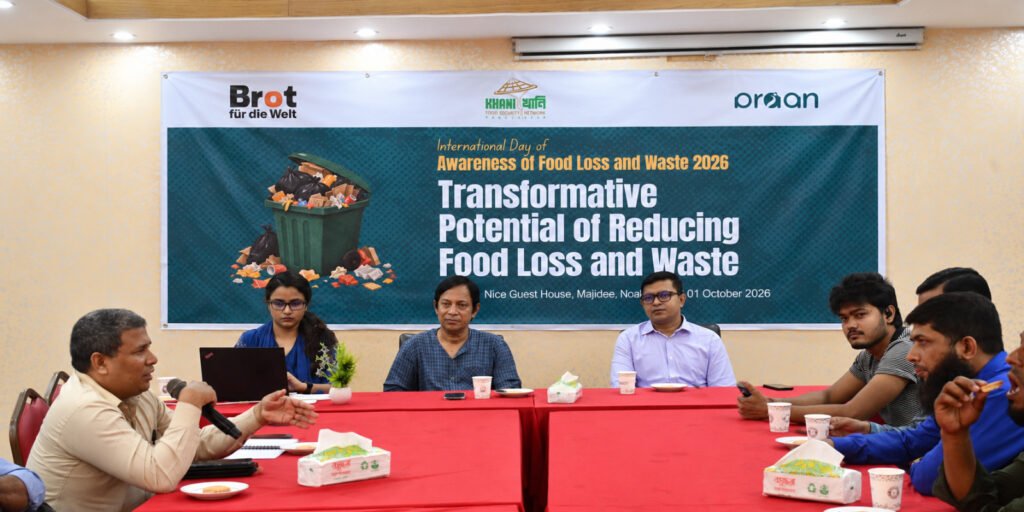
To mark the International Day of Awareness of Food Loss and Waste, a high-level dialogue meeting was held on 1 October 2026 in Maijdee, Noakhali, under this year’s global theme: “Transformative Potential of Reducing Food Loss and Waste.”
The event was jointly organized by Food Security Network – KHANI Bangladesh and Participatory Research and Action Network – PRAAN, marking the bold launch of KHANI’s flagship month-long campaign: ‘31 Days Right to Food & Nutrition’.
Taking Action: Public Accountability in the Dining Room
As part of this initiative, participating hospitality establishments made a concrete commitment to measure their daily waste and display these figures visibly to patrons.
Each restaurant received dedicated tools to maintain transparent records:
- “Food Waste” Tracking Posters: Displayed prominently in dining areas to inform guests about the volume of food wasted.
- Table Stands: Indicating the exact kilograms of food wasted on the previous day and the running total for the current month.
By making waste visible at the point of consumption, the initiative aims to trigger mindful eating habits and encourage diners to order only what they can finish.
Understanding the Roots of Food Waste
During open discussions, restaurant owners and managers pointed out that consumer behavior is one of the largest contributors to food loss. Customers frequently over-order and leave significant portions unfinished on their plates.
In some establishments serving traditional Bangla cuisine, daily food waste can reach 50 kilograms or more.
To tackle this challenge systematically, participants proposed several actionable solutions:
- Flexible Portioning: Offering adjustable portion sizes tailored to customer appetite rather than standard large servings.
- Proactive Service: Training waitstaff to advise customers respectfully when an order appears excessive for the table.
- Staff Capacity Building: Training kitchen and service teams on food handling, portion control, and waste minimization.
- In-House Awareness: Displaying visible messages and reminders about food conservation throughout dining halls.
Voices from the Dialogue
Key stakeholders emphasized that changing food culture requires shifting mindsets rather than relying solely on administrative rules.
“Law enforcement alone cannot reduce food waste; awareness about the true value of food must be built from childhood.”
— Mr. Sumadhu Chakraborty, District Food Safety Officer, Noakhali
Reinforcing this perspective, Md. Aminuzzaman, Executive Director of Bandhan and General Committee Member of PRAAN, noted:
“The root of the problem lies in the absence of these critical discussions in how we grow up, learn, and socialize around food.”
The National & Global Context
The scale of food waste is an urgent economic, social, and environmental concern across Bangladesh:
- 82 Kilograms per Person: According to the UN Food Waste Index 2024, this is the staggering amount of food wasted per capita each year in Bangladesh.
- Policy Mandates: Both the National Food and Nutrition Security Policy 2020 and Bangladesh’s National Pathway (July 2025) for the UN Food Systems Summit emphasize urgent measures to curb food loss and waste across the supply chain.
In light of these challenges, KHANI Bangladesh continues to advocate for the swift formulation and implementation of a dedicated, comprehensive National Food Waste Reduction Strategy.
🔗 Event Details & Updates: View the Event on Facebook